

ITS A WAY OF LIFE

| home |
| about us |
| exiles history |
| membership |
| our teams |
| fixtures |
| contact us |
Translation of the article about Malta in the |
8 October, 2005 Malta is really Waterpolo crazy!
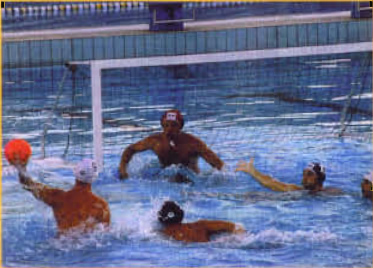
Whoever may think about Malta, perhaps first thinks about a diving holiday in the Mediterranean Sea round the island. Still fresh in our memory is probably also the 12–1 defeat that the football minnows of Malta suffered against Spain in 1983. Because of this heavy defeat, the Dutch team was eliminated from the European championships in 1984, as the Spanish team qualified on goal average. The average Dutchmen does not know that the Waterpolo lover will feel very much at home in Malta. Frequently there are Dutch clubs which visit the island situated just a few miles South of Sicily in order to participate in tournaments or in trainings camps, thus combining Waterpolo with a holiday. The clubs do not easily forget these visits. And if they attend a match at the national pool they surely will not forget it. There are television cameras in order to report the match and the next day write-ups of the match are published in the papers. Many Dutch will be jealous of the attention given by the Maltese media to Waterpolo. All in all, one may state that Waterpolo is a number one sport in Malta and that in the summer Waterpolo is just as “hot” as the tropical climate.
The competition
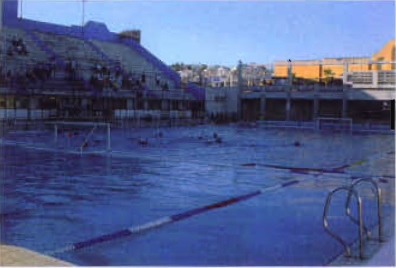
The competition is divided into 3 phases. Between March and May the teams play a winter league. This league started in 1993 when the heated National Pool at Tal-Qroqq, close to the university complex, was opened. From then it has become possible for local teams to train during the winter. In actual fact the winter competition is mainly a series of test matches between the teams. In June and July the summer competition is organised. This is the most important competition of the year. At first a preliminary stage is organised between all local clubs and then the teams classified in the first four places play in the first division, made up of two rounds. The team that tops the table wins the championship. For this phase of the competition matches are officiated by Italian referees. The remaining teams play in the second division, a competition based on one round of matches. Finally there is a knock-out series, which is similar to a ‘trophy’ competition based on direct elimination. All matches are played at the National Pool. In Malta (in contrast with Holland) only the first team competes in the national competition. So there are no official games between reserve teams. However, there is an initiative whereby “old” players from Neptunes train and play friendly games. Old players from other teams are usually welcome to participate.
2005 Championship
The summer competition of this year was decided during the final stages of the championship. The fact that the competitions are highly balanced was also evident during the following week’s final of the knock out competition. Neptunes emerged as winners after beating Sliema 12 – 11. In the Second division San Giljan won the championship ahead of Exiles. It could be merely a question of time before San Giljan is back at the top level.
Foreign playersAt the end of each competition officials of the clubs meet in order to decide the criteria regarding the organisation of the following year’s competition. The question that surely will be asked is if foreign players are to be allowed to participate in future. Foreign players from Holland in the past have played in Malta. Among these one can mention Jan Evert Veer and Hans Smits. Other known players who played in Malta where Horaz Cernohorsky (Czech Republic), Fabio Valenti ( Italy ), Igor Milanovic and Igor Gcanin (both former Yugoslavia). The level of Waterpolo improved, but the expense led to financial problems for the clubs. Besides the fee of around US$ 20,000,- (for the top players) there were also the cost of lodging, a car and meals. When the financial situation of some clubs took a turn for the worse Malta is a member of the European Union, so the national swimming association, the ASA, cannot refuse the right for EU citizens to come and “work” in Malta. Woman and youth teamsBecause of lack of interest no Waterpolo competition for women has been organised during the last five years. In 1999 there were still 4 clubs with a woman’s team but now only San Giljan has such a team. Things are better as far as youths are concerned, but even in this case only tournaments for boys’ youth teams are organised. There are 3 age categories namely Under 15, 17 and 19. These youths train very often and daily sessions of 2 to 3 hours are organised at the clubs, some of which hold their training sessions in the sea. In the evening there is a match every week at the various clubs – unless the presence of jellyfish leads to a cancellation of the fixture!
National Pool
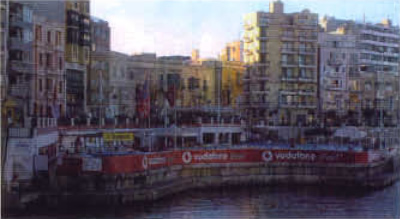
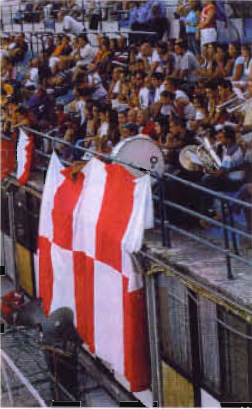
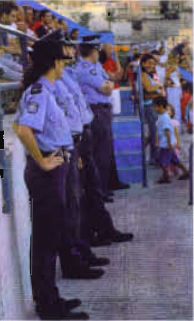
The republic of Malta is an archipelago made up of the main island, a smaller island - Gozo - and another even smaller island - Comino. The total surface area is equal to twice the size of our island Texel. All the Waterpolo matches of the major national competitions are played at the national pool. The supporters are strictly separated from each other and the “home” team at the national pool gets the head tribune whilst the opponent’s supporters are placed on the opposite side. Supporters passionately cheer for their team and adore their players. The club Sirens has a real siren, whilst Neptunes’ supporters play a big bass drum. To avoid unacceptable behaviour there is even a police presence at the pool. A “Waterpolo-hooligan” who is caught can also be taken up to court. Throwing things and jumping off the stands are strictly forbidden. Clubs can have points deducted as a punishment, depending on how serious the offence is. Even players are subject to a disciplinary system. They can all be individually suspended, also in combination with a fine. A club can also be suspended from sporting activities as a consequence of the aggressive action of a player.
The Dowling brothersExiles Waterpolo club at the moment has a unique duo of trainers on its side. They are the brothers Kurt and Dirk Dowling. Both of them run a jewellery shop in Republic Street in Valetta. Kurt has been asked to train the Exiles’ youth and does that with great dedication. He asks 110 % effort from the players. Dirk trains the first team with just as much passion. Kurt Dowling, who is very tall, has had a successful Waterpolo career. He is now 41 years old and he says that he was lucky with his Waterpolo adventures in Europe. When he was 17 he played for Duisburg in Germany, whereas in the season 1987/1988 he played with Nervi in Italy. He also had a very short spell in Holland with the team HZC Robben but before competitive matches started they parted on friendly terms. His shorter brother Dirk (46 years old) has had success with the national team which he also coached for 8 years. In 2002 in Stockholm, Sweden, at the European B championships, Malta won the bronze medal. This achievement is the highlight of Malta’s Waterpolo history. Exiles are not the first club that the two brothers are training. At every club where the duo Dowling train, the skill level of the players and of the team is certain to improve. They both have had extensive national and international experience.
The national team
For the past 9 years Joseph Caruana Dingli has been captain and goalkeeper of the national team. Caruana Dingli has seen an improvement in the national team, but the size of the island, with a population of 350,000 people is certainly a limitation. Less people means less investment and therefore fewer opportunities. Caruana Dingli is now 41 years old, and still plays for Sirens. He knows that financial limitations will impede the game from developing further. Companies are not really willing to sponsor Waterpolo clubs so if you want to become a good player you have to invest your own money. Some players also take days off from work for matches, training etc. The current national team coach Pierre Borg (also coach of Marsascala) has to face many difficulties in order to prepare the team adequately. Participating in useful friendly international tournaments is a utopian dream. Clubs like Sirens and Sliema are also forced to face the same problems. Both clubs managed to play in the European competitions but a regular participation of Maltese clubs is only a remote possibility. In 2004 Malta placed 6th in the European ‘B’ competition, that is three places lower than two years earlier. There were three important players missing but a satisfactory result was achieved all the same. It is a fact for Borg and his players that one can only reach the heights which are within one’s possibility. Fortunately there are enough players who love the game and who are willing to put time and money in it. This is pure love for the sport. It stills exists in Malta, so one may conclude that the island of Malta is really Waterpolo crazy!
Do you want to play in Malta?Is your club or team interested in playing in a tournament, organising a training camp, or just visiting the Waterpolo crazy Malta. Contact us at Manmeer on info@manmeer.nl Tell us when you would like to go there and how many people will be travelling. Manmeer will help you contact a club in Malta.
Reportage page 16 from the magazine ManMeer
|


|
|
||

Copyright Exiles SC 2005 | disclaimer | advertise with us | created & designed by chalkdesign |site map